 People & Bridges. A Story of One Passion.On those who brought the blues to Russia
Dedicated to those who cared
People & Bridges. A Story of One Passion.On those who brought the blues to Russia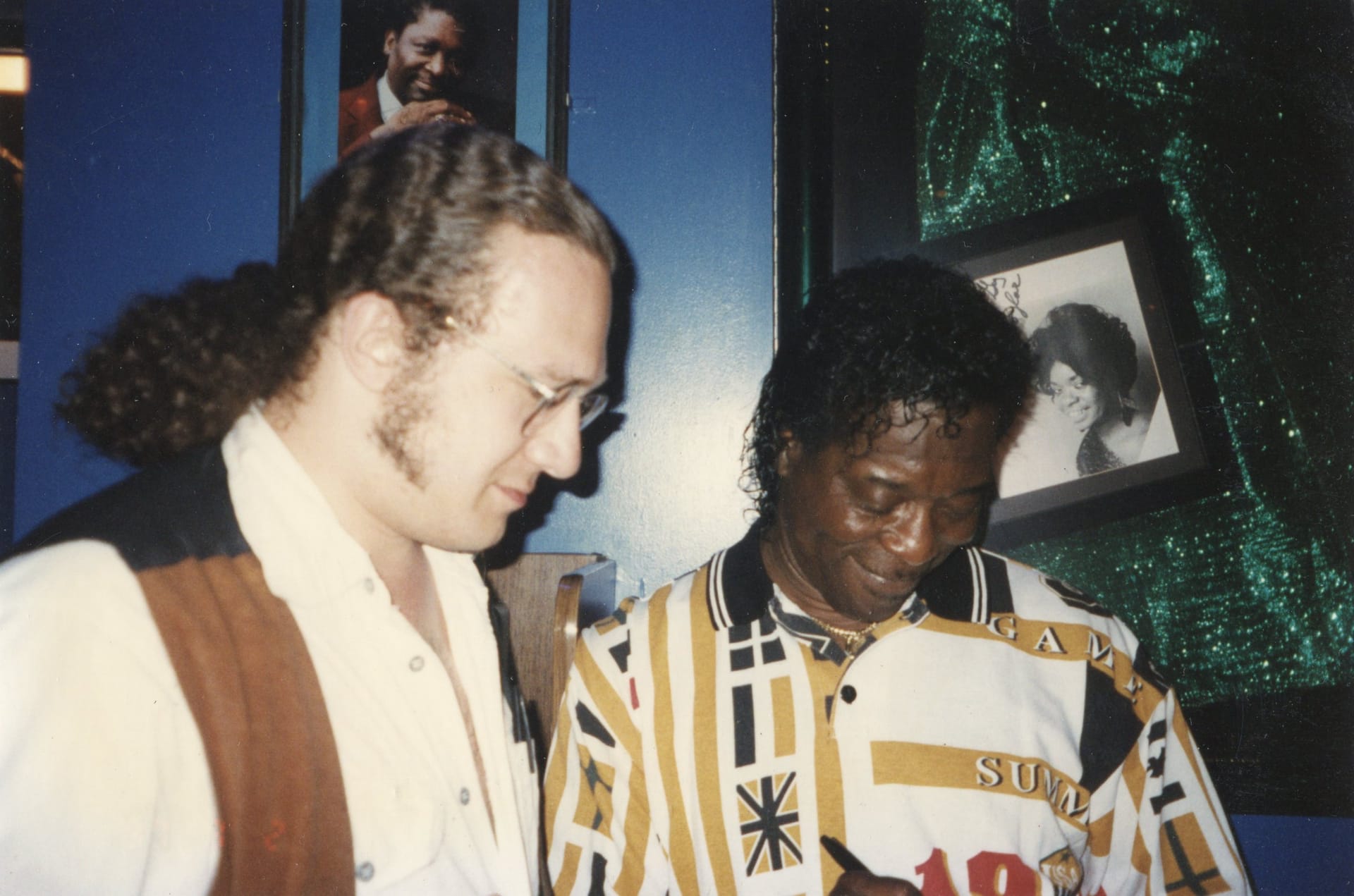
Mikhail Mishuris continues his story about his trip to Chicago, studying at a local music school, jam sessions, and a self-service laundry.
YMCA
Meanwhile, my friend was carrying out my mom's plan, persuading me to stay longer. And my visa was the kind that was issued for six months. To this day, I'm not sure I didn't mess up in some terrible way that would keep me from ever being let back into America.
In theory, I had a two-week visa, but I ended up staying for several months on my own. At departure, someone angrily pointed at something in my passport, but I didn't understand what. So I'm saying, I'm not sure I'm not still banned there.
Chicago, downtown
So my friend Kostya convinced me, and he didn't live in Chicago—he lived not far from Chicago, but in a different state. There's a university in Madison. That's also, by the way, a unique place. There was an indie studio there that recorded all sorts of great people, like Cobain. Someone explained this to me—this sharp-looking young guy—when I was riding the bus to that very Madison. He said he was going to Madison specifically for that studio.
At that festival I picked up a brochure advertising a music school for adults. We just kind of randomly went there, and I got signed up for a few courses for the whole summer. And that was it, basically—the deal was done.
The problem was that I didn't know anyone in Chicago, and we had to find a place to live in just one day.
At first we stopped at some hotel downtown, but it looked really gloomy and seemed just like the place where Elwood Blues stayed in the movie "The Blues Brothers." It was very scary, very dirty—a room with no windows, some crazy fan.
A place like something out of a horror film. It cost something rather expensive. But after we drove around all day, we decided to go back there anyway. But they wouldn't rent us the room again — they basically told us to get lost, apparently deciding we looked suspicious.
In the end, they put me in this weird place called the YMCA. It's a hostel, like a 25-story dormitory, kind of social housing. Basically, before a person finally ends up on the street, they spend some time struggling in the YMCA.
And on that same floor, in the next room, it turned out, lived Luri Bell. That was his last stop before sleeping on the street too. I ran into him there more than once — he'd bum cigarettes off me. Overall, he struck me as just some street psycho.
Then I was asked: "Do you know Lurrie Bell? He lives somewhere around here." From the description, I immediately understood it was him. And I kept running into him in clubs, though he never played there. And it turned out that back when we first arrived in Chicago, I'd actually seen him playing on the street and even filmed him, but somehow I didn't make the connection.
Well, it turns out I was living right next to a great bluesman of our time.
Concerts and clubs
I searched for blues concerts in the free newspaper; I didn't really like venturing out from the center. At most, I would make it out to the Old City.
At Blues Central I listened to Otis Rush, they took me to Checkerboard Lounge, that's the club where Muddy played with the Rollin' Stones. We went there on some kind of off day. There was a band playing, even a white one. It seemed like a gloomy place to me.
That's actually how it is in Chicago too. There aren't really any places that are "upscale and fancy" like that. The closest would be Buddy Guy's Legends, but it's touristy. And of course, the best performers, the most famous ones, play there. And it's basically a restaurant. I can't think of another club where they even serve any food at all.
A typical Chicago blues club is a rather gloomy, dingy establishment where there's nothing but alcohol—no food whatsoever.
With Buddy Guy at Buddy Guy's Legends
I wasn't familiar with some of the fairly well-known venues. And from what I understood, everything there was divided up by these communities: one crowd hung out in one place, another crowd in another place.
Around the time I started living in Chicago, I really understood blues. Before that, it seemed to me that Moscow was even kind of more interesting. And people played better there, somehow.
I've heard that strange opinion from people here too, who were in the same Chicago, in the same places I was. They say: "We play better blues than you do." Now I can't even hear such a thing. We don't play better blues. Well, my first impression back then was also "why does everyone play so badly."
And then there were breakthroughs — Otis Rush grabbed me right in the heart.
I didn't have much knowledge back then, I lacked the education to know who I'd run into. So unfortunately I missed Solomon Burke. But I saw a lot of good things.
Old Town School of Folk Music
Classes took place every day. I had lessons in singing, guitar, and accordion.
Group singing lessons were fun — we had that too, just like in a movie, with that famous elevated train going by outside the window, rumbling away, and whenever it would pass, everyone would go silent. The train goes by, and then you can continue the lesson.
To be honest, I remember the classes pretty poorly. Guitar lessons were the usual thing—someone shows you something and you repeat it. Singing, I don't really remember much of. An ensemble. Everyone would gather and try to perform whatever they could manage with our modest abilities. They divided everyone who wanted to be in the ensemble into a few groups.
At school during class
And then the director said: "Everyone needs to bring two songs." And then we played with that ensemble at Buddy Guy's Legends. We had a special student set, a school set, right before the main concert.
And the main concert that time turned out to be unusual — Luther Allison had just died, and they organized a big tribute evening for him. It happened that we even became part of that evening.
A huge crowd showed up because Buddy Guy promised to bring all the stars. I probably never would've gotten in otherwise. There was a line out on the street.
We performed, didn't go anywhere after that, just stayed by the wall. There was absolutely nowhere to sit, and you could barely stand anywhere.
There were a lot of elderly Black people there, who you didn't usually see before — it was mostly either tourists or those bearded guys in glasses, you know, the scholarly types, blues enthusiasts.
Possibly all the stars were really there. To be honest, I didn't recognize a single star. But my horizons were pretty narrow back then. I didn't stay until the end of the evening—I got tired, and maybe I missed the most important part. I read a description of that evening in the newspaper later, and I still couldn't figure out who was there. There must have been some great people.
Jam sessions
To be honest, I remember it poorly. I remember there were quite a few incompetent musicians there. The jam session host would sort of arrange everyone so it sounded more or less decent. They didn't want to let me play at all, because they'd made me out as a foreigner. Though there were foreigners around, and there were a lot of Japanese people.
At an open jam at the B.L.U.E.S. club
One Japanese bass player just sat down and played straight through from beginning to end, because there were no other bass players. It wasn't organized by a set group—whoever showed up played.
They probably thought I'd be some kind of fool. How could I sing if I could barely speak the language? Somehow I managed, though it was probably awful. I'm tempted to say they carried me around on their shoulders, but that's not true.
At music school I was in good standing, and they considered me a promising prospect there. But at jam sessions I can't say that people were lining up to embrace me.
Chicago Blues
Chicago blues, as I understand it, is a pretty eclectic and rough-and-tumble mix of all kinds of styles — there's no refinement to it whatsoever, but it's got funk, soul stuff mixed in. And that garage rawness, that's what draws me in. Because when I heard California artists later, say, everything there is much more refined, much more polished, but that Chicago recklessness, that wildness — it's just not there.
But there's this special charming roughness to it, and they can just slip a pop song right into the repertoire.
It happens that musicians play shuffle with such fierce seriousness that the veins stand out on their foreheads. I didn't see that in Chicago — there it was all lightness.
And whether it's musicians on the street or musicians in clubs: they play at different levels, of course, but it's blues, and with us it happens—and I mean "with us" broadly, in Europe too, anywhere really—where everything seems even, everything's great, everything together, but what comes out is somehow not quite blues.
And there's a band playing out on the street, everything's off-key, everything's crooked, nothing's in tune, but he just goes ahead and plays the blues anyway
The Laundry
When I realized I'd run out of all my clothes, someone told me there was this thing called a laundromat. That was also unheard of. Back then it was completely incomprehensible what that could even be. That there are washing machines standing there, you buy detergent and wash your own clothes.
You're drying them right there. And the fact that in comedies a man without pants can just sit around waiting for his pants to dry—that's actually a workable scheme.
Well, I had to go to such a laundry too. I asked at the reception where to find one, and they gave me an address. I looked it up on the map and saw it was quite far away. But I still couldn't figure out how to get there by public transport.
I was honestly scared of the transport too, you know. I could manage a few subway stops in a clear direction and get to school all right. But going somewhere off in another direction—I was afraid of that. The first time I went to that laundry, I took a taxi.
I never ran into American taxi drivers—they were always some pretty wild characters. Even if it was a Black guy, he'd definitely be from Africa and speak no understandable language. But it was easy because I communicated uncertainly, while they spoke with confidence but incomprehensibly. At least I felt like we were on equal footing. I could manage to show the taxi driver a piece of paper.
With a music school staff member
And the metro there was pretty funny. I learned how to ride it to school. One time we stayed late at a bar after class. I went to the metro—they have night service there—but the station I needed closed around 10:00. I got there and the station was still open, but nobody asked me for a ticket. And there was nowhere to put it anyway, the turnstiles were open. I was worried they'd fine me heavily, put me in jail, do something terrible. But it turned out that right as closing time approached, the station just stood open with no staff around—you'd go in for free and ride.
Anyway, I was really worried that I couldn't buy a ticket. I'm going for free. How's that possible? I mean, I had just enough adventurousness to leave for America.
Return
I liked America more than I expected, and I really fell in love with it. But there was no thought of staying there—I probably disappointed my mother. Instead, I thought: "Oh, how cool, I'll go back now and tell everyone everything and start implementing all this." So that's what blues is, it turns out. We're going to make something happen there now!
And the whole band managed to convey that inspiration. We just dug in, started working through some things, more or less the right way. And almost immediately headed to Moscow.
Looking back, I realize that was almost the most important time in my life. I didn't use that opportunity a hundred percent, of course—God willing if it was fifty—but the fact that it happened, it's absolutely clear: if it hadn't, my life would have been completely different. That's when I came to believe that blues could and should be played. And most importantly, I realized I could handle it and that I could fit into any scene.
And, again, I'm saying, probably my knowledge just wasn't enough to appreciate how skilled the musicians were, but they weren't really there for the sake of being skilled, they were just part of the regular atmosphere. It was rare that people would come to a concert mainly on Friday evenings in summer—Americans in shorts would hang out bar to bar: listened there, listened to someone there, and didn't even know who it was.