 People & Bridges. A Story of One Passion.On those who brought the blues to Russia
Dedicated to those who cared
People & Bridges. A Story of One Passion.On those who brought the blues to Russia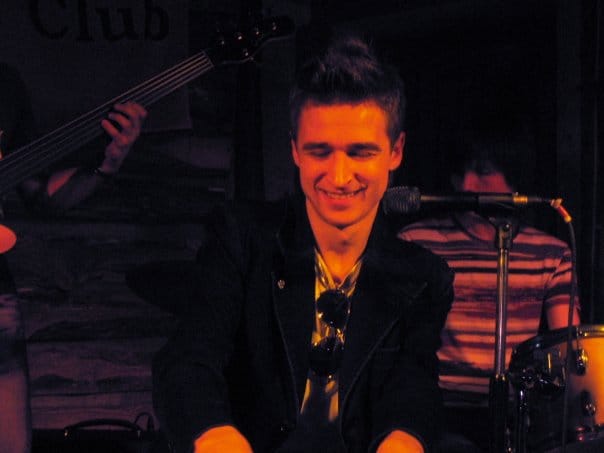
Artemiy Krichevsky is an iconic figure for the Minsk scene. His band Spoonfull (the name was always spelled with a double l) became one of the first purely blues groups in Belarus. Moreover, Krichevsky, nicknamed "Batka" by the younger generation of blues musicians, played in numerous reggae and rock projects.
From 2003 to 2006, Artemiy Krichevsky became the official guitarist of Svet Boogie Band, with whom he recorded the famous DVD Live in JVL and the studio album Nothing But Love, better known as "the green one."
Krichevsky on how he taught Sveta to play the harmonica, why he called him "Big Mouse" (as it's written on the albums), about the trip to France, and the concert for dangerous Polish rockers.
Svet and Artemiy Krichevskiy
Introduction
I studied at a technical school, my friend put together a band called Mucha, and we played whatever we liked — basically Aquarium covers mostly. We recorded some stuff in my basement on Avtozavodskaya.
And Vanya, our leader, had a younger brother Denis, who was studying in school in the same class as Svet. And so they came by our rehearsal.
We had a piano there, and Svet started playing something on it. I think it was "Bohemian Rhapsody." And he played it like this: he'd start the intro, get to the vocals, sing "Ma-maaaaa" and then stop right there.
Well, we decided to play together. It turned out to be some kind of nonsense, a couple of rehearsals and that was it, we all scattered: summer, vacation.
That's how they met, it turns out, when Svet was still in school.
Vanya later recorded something with "Mukhа," and I started creating my own band focused on blues.
Spoonful
When I was finishing technical school, I caught a Voronov concert at the Palace of Unions. And we, poor students, were always trying to sneak in somehow. We found some guy there—a janitor or a doorman, I don't remember which. We brought him two bottles of port wine, I remember. Because we knew he was the type who could be bribed.
I remember Voronov performing in this long shirt with huge daisies on it. After that concert, something clicked for me. And right then I managed to watch the film "Crossroads". One thing on top of another, on top of a third, and that was it. It all clicked.
And so we just started playing on our own.
My friend Antoniy, who once got me hooked on the Beatles, used to say: "There. Nothing better has been invented yet," He moved to Moscow and came back a year later a different person, completely into blues. He didn't play himself, but he listened very intently. That's just his nature—he needs to master the information.
And he started from the very roots—his principle was: the more contemporary, the less authentic. The deeper you dig, the cooler it gets. He bought a hefty English-language tome, Who's Who in Blues, and sent me photocopies from Moscow.
It feels like I was born with the blues—it didn't happen right away, it came over time.
And we started playing in the courtyard of the Pingvin ice-cream café: a small mixer, drums, bass, two guitars—everything through one speaker.
So it turned out that our guitarist Andrey Svetlitskiy lived in the same entrance as Gennady Starikov, who started organizing a blues club—basically got the whole thing going in Minsk. And he'd put on concerts regularly. That's where our whole blues community would cross paths.
Over time Spoonfull somehow stopped playing, and Svet called me: "I need a guitarist, here's the situation."
Harmonica
Back at the Muha, when we first met, I was already playing a bit of harmonica. And Svet got interested. So it turned out to be this Minsk harmonica legacy.
There was this great harmonica player named Maks (he spelled it with an "kh" for some reason), and I saw him at a compilation concert. Well, I'd already watched the film "Crossroads" by that point, so I wanted to play harmonica too, but I couldn't figure out how these guys make those bends. I'd blow and blow, but nothing. Turned out you have to draw the air in. And he just showed me, and I didn't put the harmonica down until I got my first bend, and once I got that first bend, I basically never put it down at all.
And when Svet asked, I showed him the same thing that Max had shown me. How to put together bands, and the rest depends on self-perception. But Svet far surpassed me in skill, of course. Whatever he took on, he brought it to perfection.
Big Mouse
And then Svet called—their guitarist Lesha Shilovich was heading off to England somewhere, and they needed a replacement. They already had their set list. And over time, Svet decided that playing like this was fine, but they needed to actually make some money from it.
Svet is very sociable, he strikes up acquaintances instantly, all the way to friendship. In Moscow he had Volodya, who organized concerts. And at every concert Svet would introduce everyone at the end and would always say: "And there in the hall, in the corner, that big bearded man, that's our director." He called everyone different things all the time, but always kindly.
He tells me I need to introduce you somehow, you know, when you're playing a solo, or you've already played one, or you're about to start, so it sounds good and fun and doesn't feel insulting.
He noticed that when I start playing, my face contorts and my mustache twitches. Like a mouse's whiskers at the sight of cheese. That's how I became a mouse, just a big one. Mister Big Mouse.
France
What struck me most was the trip to France—it was incredibly intense. The impression came mainly from the people, a completely different culture. Everyone there seemed so kind. I barely noticed any mean-spirited people.
Although there were many revolutions in France. Probably they have enough anger there when needed.
Well, the architecture is so-so, to be honest. Though Tyoma Gavryushin, our bassist, kept filming everything, absolutely everything he could. Even ornamental door handles.
And from the concerts, the last one stood out in my memory.
We lived in a small village and played a free concert there as a farewell. A friend of ours, Sveta Letisiya, invited us to France; he later wrote a song about her called "Little Tia." She was living in that village with her husband.
In two weeks we played ten concerts, and Leticia and her husband drove us everywhere. They went ahead in this little "heel"—that's what we called it—with all the equipment, and we followed in our own car.
And so the time came to say goodbye. In this little village there was something like a school, and in it a gymnasium that doubled as a dining hall, where we played.
I liked that even in such a small town there was a mayor. And this mayor himself was climbing around on ladders, screwing in some lights, kind of spotlights. He climbed around and screwed them in himself, did the wiring.
Internally, in terms of how it feels, when you play not for money, but just like that for people, you play completely differently. Honestly, much better. For me personally.
Billiards
We played in Poland, at a club—not a blues club, just a regular one with a billiard room. We arrived in the morning, said hello, got our heads straight, and we had about four hours before the concert.
And regulars came there—the kind who hang around all day, these rockers with beards and skulls on their shirts, leather jackets, clearly into Metallica.
And we were in little suits, ties, just like the band Secret. Svet says: "It looks a bit dodgy, but never mind, we'll make it through."
I've loved pool since childhood. My grandfather taught me—he was from Nikolayev, not far from Odessa, where pool is serious business. Anyway, I asked them to give me a cue.
Started shooting pool: one-two, hadn't played in a while. This "rocker" guy comes up and offers to play. I don't speak Polish, so our conversation went something like this: some English here, some Polish there, some Belarusian somewhere.
He proposed we play for beer. Well, okay. Honestly, I wasn't really nervous. I mean, it's just beer, what's to worry about? But the guy was kind of aggressive, or maybe just weird. He clearly wanted to show who was in charge. And he started playing decisively, like he was going into battle. Made a bunch of mistakes. And I'm playing nice and easy, nice and easy. I scored about five, he only got two.
Here Svet came over, Babty came over. That's what Svet called our bass player. At first "babula" because he was big and kind, and then "Babty" because it sounds shorter.
And there they stand, already sort of rooting for him. "Come on, come on, Artemiy, come on." That's exactly what I didn't need. Just so they wouldn't get in the way. A stroke. He had a stroke too. And such a lucky stroke that I couldn't miss anymore.
I say: "Well, that's it, buddy, beer's on you." He understood it in Russian. He brought a bottle, and I say: "Get my assistants some too." The bartender puts down this plastic pack of fifteen cans. I remember Holsten like it was now.
And the concert was a real hit with that audience. They didn't expect guys dressed like that to deliver such powerful blues-boogie.
Svet immediately told us: "These softies won't budge, we'll start right in with the bugeshniki."
And it worked. Perhaps the only time we played for an audience like that.