 People & Bridges. A Story of One Passion.On those who brought the blues to Russia
Dedicated to those who cared
People & Bridges. A Story of One Passion.On those who brought the blues to Russia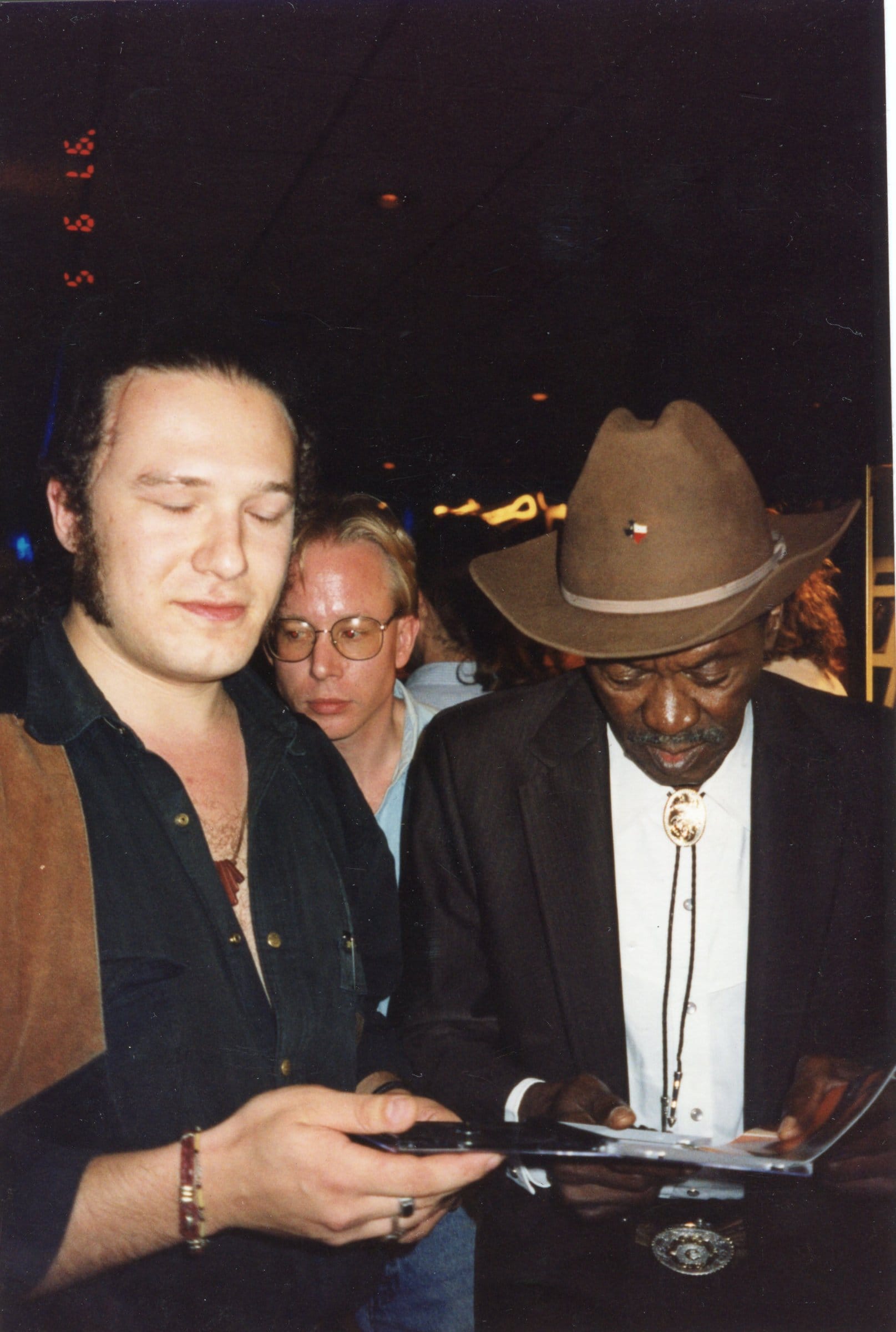
Everyone who's heard of Mikhail Mishuris knows that he first became truly acquainted with blues in Chicago, which is like meeting the electric guitar straight at the Fender factory. But the details of that very trip are somehow hard to come by. So we talked with Mikhail about the Chicago Blues Festival, America as a road movie, living in the same dorm as Luri Bell, and, unexpectedly, about french fries.
Exchange
In '97, times were such that it was very fashionable for exchange students to go abroad.
And my mother just dreamed that I would go somewhere too.
But since my specialty was "Russian Literature of the Nineteenth Century," it was completely unclear with whom I would "trade" and why.
Mikhail Mishuris on Wabash Avenue
That private university I attended in Novosibirsk actually practiced those kinds of exchanges. As far as I remember, all the economics majors eventually went to study in the USA, and some even stayed there.
There was naturally nothing to do in philology there.
Well, I wasn't really keen on going anywhere back then, strangely enough. Things were so interesting for us, and opportunities were just pouring in from every direction.
Well, I had two best friends who ended up in America. One of them left with his parents as soon as it was possible, and the other went there on one of those exchange programs. He was planning to settle there, but in the end he didn't, though that's fine.
As we recall, there were no mobile phones back then, and one time he called me from America itself, but I wasn't home, so my mom picked up the phone and convinced him to somehow persuade me to go to America. And when he found out that I was into blues and was even playing something there, he sent me a fax at work.
A fax with the Chicago Blues Festival program. It was a symbolic "Hundred Years of Blues." Three days of the festival, or two—I don't remember. And literally everyone was there, everyone I could have imagined. I suddenly got fired up thinking, why not go and see them all at once?
And I was really just calling myself a blues fan back then. There was zero information. On one hand, blues seemed like some kind of branch of jazz. Jazz enthusiasts had some Polish records with blues on them. Rock fans might have had some blues lying around too. But mostly reissues from the people's democracies. Yugoslav, Polish, East German records.
I went to record flea markets. I never, not once in my life, saw a single blues record there, or soul and funk for that matter. It was all classic rock, classic rock everywhere. Nazareth—you'd look anywhere and see Nazareth, Queen, and whatever else.
Well, anyway, I once came across a Richie Havens record at that very vinyl flea market. Or rather, not me personally, but us—we had a group of enterprising friends who would go around trading records. Anyway, never mind Richie Havens.
They convinced me to go to America after all. And I went for an interview in Moscow.
To New York via Moscow
In Moscow I had relatives, and while I was staying there for about a week, my cousin introduced me to the blues community, took me to Arbat Blues Club, and I met various people there.
One of the first was Petrovich. Petrovich took me to the Forte club, which had just opened at that time. And I was amazed at how vibrant life was in Moscow, and I thought I needed to go to America.
First impression
A couple of years ago I ended up at Istanbul airport, and that's roughly what I expected from Kennedy Airport: huge spaces, crowds of people. I found myself in an arrivals hall—quite a small one, really—basically no different from Sheremetyevo.
And I sat there and sat, my friends were supposed to pick me up, but they went somewhere else. In short, they were about two hours late. I didn't know what to do with myself. Well, thank God, they picked me up, everything was fine.
First we went to see a friend of ours in New York, then we drove to Niagara Falls, then to Chicago. Basically, it was a lot of fun. The road, all of it. I was struck by how much it all looked like a movie — the landscapes, the cars, all these characters at rest stops and gas stations, just like a road movie.
This is probably the most fascinating part of America, and after it I really came to like America.
Somewhere in Chicago, lost to time and unclear exactly where
French Fries
I must say, it was a time when I had never eaten Japanese or Chinese food in my life, for example. Not to mention Mexican.
I dealt with McDonald's in Moscow, but very superficially. And generally I didn't have much to do with fast food back then — it was 1997, after all.
In general, I had to get used to all this, especially when I stayed in America.
And on the very first day we arrived, we hung out in New York first, and then went to sleep at a motel.
The motel was actually in a different state to make it cheaper. And that's where I ran into a Wendy's burger joint, which showed up in Moscow later, by the way.
And that's where I had my first independent experience ordering food at a fast food restaurant, because all my companions were asleep and I got out to look at Pennsylvania.
And there was grass everywhere, all green, truckers, and this burger joint, I was sure I could handle it. And they almost understood me.
Besides the potato moment. I hadn't heard anything about french fries either.
I started demanding some french fries, and they couldn't figure out what this guy needed, what free fries. I felt like a complete idiot, couldn't even place a simple order. And in New York they would've figured it out in a second, they've seen all kinds there.
And this was Pennsylvania. A frightened Black girl ran to get the manager. A white manager came and started speaking to me syllable by syllable, talking to me like I was mentally slow. I still didn't understand anything. In short, I was very upset until I saw that very potato—they were handing it out to someone. I said, "That's what I need." Well, everything became clear, everyone laughed, and everything was suddenly fine.
Everyone started patting me on the shoulder, saying, "Nice work, man." And this Black girl called another girl from the kitchen, come look, some guy from Russia showed up.
Everybody came here to see me, and there was this Black farmer sitting there in a denim overall, just like out of a movie, wearing a baseball cap, the whole thing was just right.
He was finishing his coffee and clearly disapproving of it all, apparently thinking they were making fun of a foreigner. Then, when I'd already sat down with my tray and was finally about to eat all of it, as he was leaving, he came up to me, gently put his hand on my shoulder, and said: Welcome to America. Have a nice day!
Apparently, he decided to smooth over the impression.
For me, the main impression from America is that it's really just like that. And everyone always tried to help me.
I tried to communicate there with émigrés from our country, but they seemed absolutely ghastly to me. Thank God, I didn't have to interact with them.
With Clarence "Gatemouth" Brown at Buddy Guy's Legends
Chicago Blues Festival
And so we went to Chicago for the festival. It was free—the biggest American free festival, I think. Everyone was really there; you just had to run from stage to stage.
I took a while to get into the music, to be honest, because I'm not really good at listening to live music in general. For me, live music is something you enjoy in a bar, when you're relaxed, with a beer—and then almost everything sounds good. But this was an open-air venue, and it was hard to concentrate.
So that the impression came later, you know. But here I was simply struck by the sheer scatter of names and possibilities in themselves.
Buddy Guy performed on the big stage. Rufus Thomas impressed with a big band, also everything on the big stage. On the small stages there, really cool people performed.
On other stages Charlie Musselwhite sat with his harmonica, then old John Brim, and Homesick James was there too, also old.
In general, everything on the big stage had large ensembles with horns, and I liked almost all of it, though I was sitting pretty far back and couldn't really see much. But between the small stages I had to keep running back and forth.
Missed a lot of good stuff too.
In the evenings we'd go to clubs, but they were packed during the festival weekend. For the same reason, it was impossible to find a place to stay in the city. We did the same thing we'd done in New York — drove out to some other state to sleep in a motel. So I was completely dependent on my companions. They'd say, okay, we're tired, and that would be it — nightlife over, time to find a bed.
At the clubs in the evenings, well-known people played too, but I'm saying again, it didn't really make a strong impression on me back then.
I was impressed by the wealth of choices, and by the fact that all these names—which I'd only heard about, or heard that such records existed, had never even held them in my hands—were suddenly walking around, and you could even get an autograph or take a photo, but I was somehow afraid to.
I only got a photo with John Mayall, because I really didn't expect to see him at all.
He was my biggest idol back then, because I could get his recordings in Novosibirsk. We had this enthusiast there who dubbed everything for me.
I got his autograph from Mayall, took a photo with him—that was the main achievement for me.