 People & Bridges. A Story of One Passion.On those who brought the blues to Russia
Dedicated to those who cared
People & Bridges. A Story of One Passion.On those who brought the blues to Russia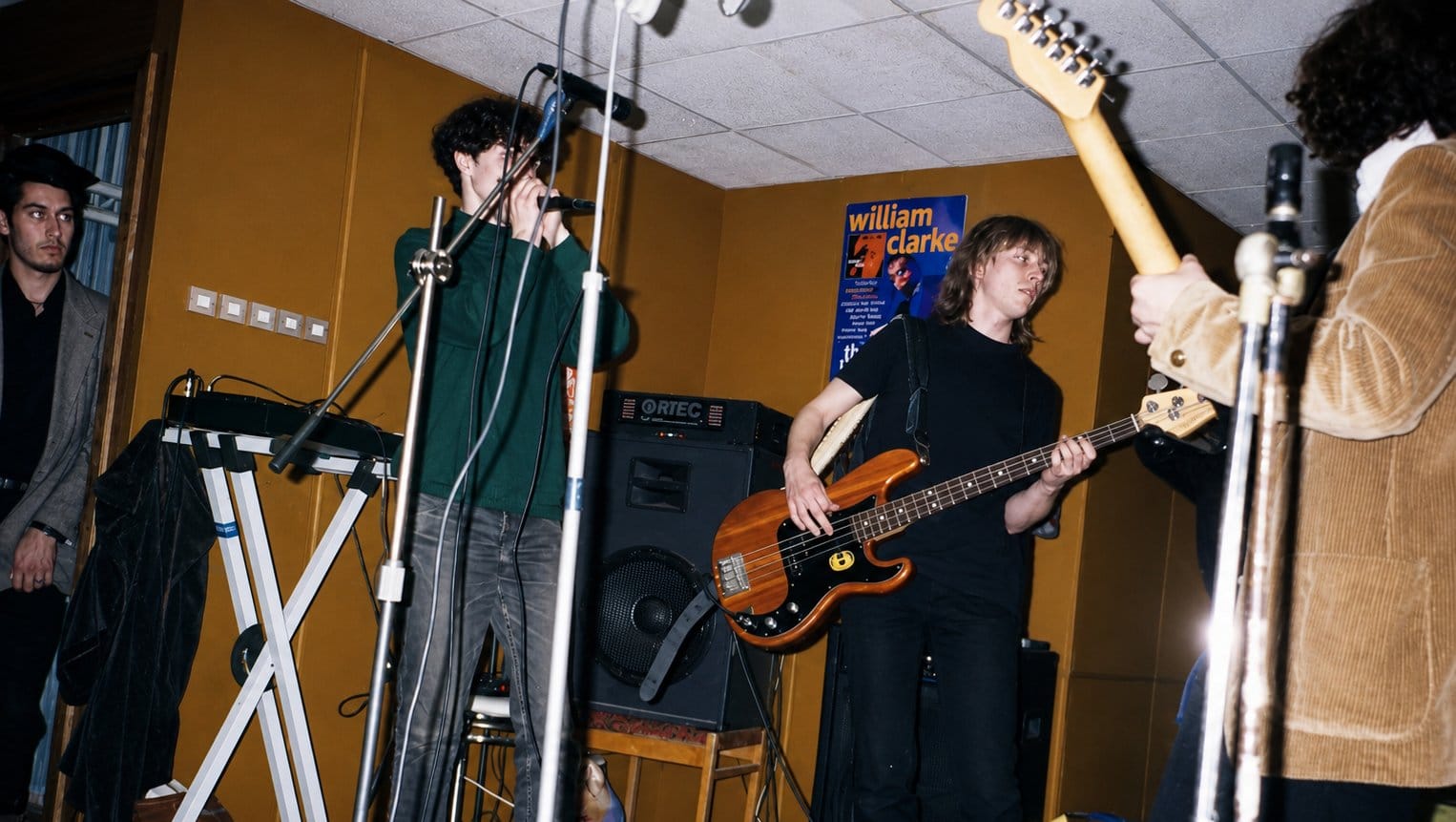
"When this club emerged, it was a very special era indeed, one that seems enviable from the perspective of today's blues reality."
Alexei Kalachev, longtime host of the program "Doctor Blues," founder of the website bluesnews.ru, tells the story of how the legendary blues club in Belyayevo came to be, how it survived, and how it made it through the difficult years of 1994–95.
"Doctor Blues"
I had a show called "Doctor Blues," which still exists, that aired on FM radio. It had such a "personal" audience. In other words, everyone who was involved in blues in Moscow listened to it.
And at some point the idea came up to create a fan club for the show. I had a huge mailbox back then, a million phone calls—people would even come specially to meet me. I treated the whole thing pretty casually at first, but before I knew it, an actual fan club had formed around the radio program, with nearly three hundred members.
And this club began to hold "sessions." I performed there, gave lectures, and musicians played there.
The radio station where this program existed had a building, a concert hall, and so on. In other words, there was a foundation for it.
At some point this club outgrew its venue. And someone suggested that since we no longer fit here—there were almost 80 of us—let's turn this fan club into something with concerts over there. To be honest, I don't remember who. Maybe one of my close friends, or just some random person.
Gallery
And so I found myself at the doors of this art gallery in Belyayevo. God willing, I think it still exists today, even thriving.
There was a concert hall under that art gallery. And we almost immediately made an agreement with the lady who was the director of the gallery that we would use this hall—I'm not sure of the capacity, maybe 70 people—for such bohemian purposes.
So I'll be organizing weekly club meetings here where I'll perform. There'll be music, a small buffet. Everyone will be very happy. And the proceeds from these evenings will go to the gallery. In other words, we're unofficially renting the space.
The times were turbulent, but in their own way very interesting, captivating, thrilling — complete chaos and vivid colors all at once.
And, by the way, we made an agreement in good faith, without signing any papers with this gallery, that I would set up a fan club there for my show "Doctor Blues."
Sessions
Our meetings were called sessions, but in reality they were full-scale concerts that sometimes lasted three hours.
It looked more like an underground Soviet club, a music club or bohemian club of the kind that existed in the '70s and '80s, where famous rock bands of today used to perform.
I want to emphasize that this was a special, distinct time that will never happen again. A completely unique era for blues, when it was in such extraordinary favor that whatever you called blues, wherever you wrote it—even on a fence—people would come.
But the thing about this Belyaev basement was that everyone who came to these parties received a personal invitation.
Organization
Here's how it worked: there were several people who would call every member of the "Doctor Blues" show's fan club weekly. And each person received an individual invitation, and we knew almost exactly how many people would come, how many sandwiches we needed to make, how long the concert would last. It was absolutely wonderful, thrilling.
And there were several enthusiasts there who essentially made that club what it was. My role was modest: to host a program that tens of thousands of people listened to. At that time, there was a blues boom happening in the world. Moreover, a new medium and new sound came into the world — the compact disc.
And all of this was multiplied by a new discovery of blues as a genre in America and around the world, with all the consequences that followed. And so I found myself riding the wave of a trend, as they say now.
And besides, I had good friends.
Oleg Mansurov, who brought a whole truckload of beer every week. He was selling it somewhere at the markets—there were a lot of markets in Moscow back then. He brought this beer to Belyaevo.
My wife was making sandwiches. My seven-year-old son, even then just six, helped me with everything and even collected money at the entrance, sold tickets. That happened too.
And then we got absolutely nothing out of it, because at the end of the evening I'd pay off the musicians, the gallery, the people who brought the beer, and I'd only have money left for a taxi.
But all of this was, I want to emphasize, thrilling and, from a musical standpoint, brilliant.
Musicians
We had everyone perform here, starting with Petrovich and Arutyunov, all the stars of Moscow blues. Levan Lomidze had just arrived from Europe back then, playing a white Fender.
There were a lot of really interesting figures, not just musicians. People recited poetry, some girls would come and present some kind of blues costumes, though I don't even know what blues costumes are supposed to be.
But the main star was Roman Gegart, one of the best diatonic harmonica players in Russian history. And he and his band King Biscuit became our house band. They were very young and wonderful, and I'm still very grateful to them.
Andrei Evdokimov came by, we gave some speeches there, I read poetry by the same Langston Hughes, so we had a very interesting poetic section.
Everyone had Gary Moore in their heads, but gradually there formed a kind of musical community that swung in its tastes from Gary Moore to archaic figures like Charlie Patton and Robert Johnson. So the music was very diverse.
And the face of this music was defined by several musicians, Muscovites above all: Alexei White Belov, Petrovich with his band, Borya Bulkin, Levan Lomidze, Roma Gegard with his guys.
And this was the first wave of Russian slingers, guitarists who sang and played electric guitars. First and foremost, Fenders were very popular.
Repertoire
Blues was the kind that Russia heard on compact disc in the early 90s. A wave of music simply swept over not only the blues community that had formed back then in the early 90s, but also the general public at large.
As for the breadth of understanding blues, yes, it was the same as it would remain in Russia forever:
Let's say new artists would come to that same Belyaevo. Back then everything was simple, without any formalities. A musician would call me at the radio station and say: "I'm here from Lvov or from Krasnoyarsk, I play blues." Oh, great, great, hello, hello. Perfect, come by our club on Friday. I'd be happy to. So, what will you be playing? I'll play blues, the way we play it back in Krasnoyarsk or somewhere like Chernivtsi.
And these guys would come in, often really charming fellows, and crank up some Russian chanson mixed together with Hoochie Coochie Man. That is, such blues hardcore mixed in with all sorts of other trash that was pouring over the airwaves. Well, what can you do, you can't stop a concert, so you'd just have a laugh with the audience, who understood that this wasn't blues.
But on the other hand, people did try. They'd give them a hundred rubles, say thank you, and never call them again.
There were so many bands and performers who played blues in their own way, or who fundamentally misunderstood the very nature of blues itself, yet still considered themselves bluesmen and were convinced they were making blues music — there was one in every two.
That's why the breadth of understanding and the term "Russian blues"—it persists to this day and has become fixed in place, even though it has no relation whatsoever to blues. This was, is, and always will be the case in Russia. That's the kind of blues country Russia is.
The '90s
This was all happening in 1994-1995, so we had our "encounters" with the police, and with anyone else who showed up. It happened regularly. Sometimes it took on comic forms, sometimes tragicomic ones. But the thing was, we had worked it out from the start with the gallery and the art world — they basically had our backs.
If a crisis situation arose, I'd call the gallery director or her deputy—also a very tough, no-nonsense, militaristic sort of guy who knew how to deal with the official authorities. So if, say, a police unit showed up and said, "What's happening here is illegal under the law," blah blah blah, and so on.
Then this Sergey appeared on stage, and they quietly talked in the corner. And everything was resolved to everyone's satisfaction. In the end, with some payments made to these gentlemen, who would then leave.
But sometimes it went differently: when a few tough guys in red jackets would appear in the middle of the hall, with stern faces, and say, "So what's going on here, guys, what kind of music is this?"
They were somewhat bewildered, didn't know how to behave, because the audience was clearly young, predominantly students. That too was in the spirit of that era, that time. The blues audience was mostly young, because blues burst in as a young music into Russian reality from behind the Iron Curtain. And instantly young girls and guys fell in love with it, wedged themselves into this music. For a short period, though, unfortunately.
And yeah, the cops could see it was clearly some kind of student party. The hall was packed to the gills. Well, I went out, started talking to these gentlemen. Well, they, as is customary in that bandit genre, were generally taciturn and stern. I talked to them, handed out some money for beer.
They wagged their fingers at us, saying, "Now look here, keep it down!" And then they'd walk away.
There were unpleasant incidents with violence, but we had our own resources for such cases: a few military personnel in the audience.
There was an Afghan guy who was involved in the security system for these parties. There was Oleg, my buddy, a really impressive athlete, a wrestler.
You didn't have to look far for muscles, if that's what was needed.
There were a lot of drunk people, drug addiction. They got rid of people like that: they kept an eye on them and kicked them out of the fan club.
There were touchy situations, there were questions with fire safety. Once a person lost consciousness, but thank God, there was a doctor in the audience, and we were able to revive the visitor.
Children
There was this time when some kids came by, and of course we let them in for free, got them seated, gave them sandwiches. They were looking around, interested in everything, nobody gave them any trouble. And then one of them came up to me and asked: "Uncle Lesha, can we come back again?"
I'm saying, come on, come by, and bring your parents along too. They exchanged glances and never showed up again.
Closure
Every culturally enriching and entertainment project has its expiration date, after all. It exists for some time, and then various toxic details start to surface. Every project has its own threshold of exhaustion.
I don't remember how the story of the club in Belyaevo ended. I think I changed jobs, my circumstances changed. And since time was moving so fast back then, everything was changing quickly, and the show moved to a different radio station, and people started to scatter and become interested in other music.
Time itself, in a way, drew a line under it all. You can't just burn out and keep going on sheer enthusiasm with such large-scale undertakings that carry all the well-known risks—organizational ones, and legal ones too.
So it ended on its own schedule, naturally. There was no conflict, no breakup, no cancellation, nothing like that. The club simply didn't open for the next season. Some people moved on to other jobs, some left for another city, some got married. And that was it. That's how it all ended.