 People & Bridges. A Story of One Passion.On those who brought the blues to Russia
Dedicated to those who cared
People & Bridges. A Story of One Passion.On those who brought the blues to Russia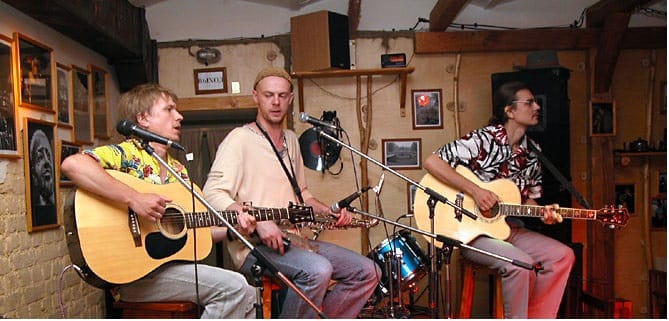
"I wanted to do it the way that got me off."
The term "blues" itself is, in my view, quite narrow and rigid. Move a centimeter to the right or left, and no, that's it, it's not blues anymore. Look, I'm not going to argue about terminology, it's just that my tastes are somewhat broader than the narrow, orthodox definition of the word "blues."
"Dom u dorogi" ceased to exist in 2017, but to this day musicians throughout the CIS, when they hear the word "Moscow," automatically ask: how is "Dom u dorogi" doing? Yuri Ivanovich Kostin, founder and ideologue of the most important club in the history of Russian blues, talks about how the first incarnation of "DuDa" came about, why medical workers fell in love with the club, and how the famous jam sessions took place.
The Beginning
In 1993, a place called "Armadillo Bar" opened in Gostiny Dvor. This was, essentially, the very dawn of such market-driven bar-restaurant culture.
You could talk about Armadillo for weeks. It was an interesting establishment in its day. The fact is, there were concerts there. Petrovitch, for example, the same one. I mean Mikhail Petrovich Sokolov—back then his band was called Stainless Blues Band, I think. Then Voronov performed there, and that's where he and I actually met. Later Kolya Arutyunov performed there with "Blues League."
It seems there was Levan Lomidze back then — he played with his cousin. That's why they called themselves Blues Cousins.
In general, I think I saw live musicians around '93 or '94. And I was hooked.
At "Armadillo" I worked for several years, then with those same company founders, let's call them that, we opened a bar-restaurant in Sokol, Jack Rabbit Slims. That was probably '96.
And there I also wanted to do something musical like that. And at some point we met a legendary man who few people know about, named Sasha Nikishin.
He's a musician, a sound technician, all of that—he knew everything about equipment, he played himself, had his own bands. He started way back, even in Soviet times I think, managed to catch the tail end of it.
And so we started organizing events there on Sokolniki, at that Jack Rabbit place, I think on Thursdays. And that's where I met Mishuris, and Agranovsky, and many others.
And then I got really fed up with the whole thing, to be honest. I really wanted to do things the way I wanted, not the way someone else wanted me to.
And in 2002 I told the guys that I couldn't do it anymore, that I wanted to do what I actually wanted to do. If you want to come with me, great, if not, that's it, I walked away into nothing.
And with a comrade too, another old comrade, we found a place right on Dovator Street, at "Sportivnaya," and we set up this establishment there.
John Primer at the House by the Road
House by the Road
Originally there was no goal to "make blues," I just wanted to create a good place with music I liked. In other words, diverse music.
And what was included there? Well, let's say... Well, all the artists I've already mentioned, they basically played there. The same Agranovskiy, Petrovich, Sasha Nikishin with his band... Then I talked with Fyodor Romanenko, he recommended someone else to me, and, as they say, the repertoire gradually began to expand.
And so it just kind of took off... It all came down to not doing things the "right way." First of all, nobody knew what the right way was, and second, nobody could tell you, even though of course there were plenty of people who knew how it should be done. But what I really wanted was to do it in a way that got me off.
So there's Fedya Romanenko, and Andrey Evdokimov — we got to know him right away too, back in 2003, he was living just nearby.
Fame came gradually, and honestly, there was never a goal—not even at the very end, when it was all already over—to create some kind of club that would be amazingly cool, important, the main one.
There was a desire to make it so it would be fun.
Bob Brozman at the House by the Road
I figured it this way: I'll do what I like, and Moscow is a huge city. Surely among those 15 or 20 million people there, I don't know, a thousand people or however many, there will be some who like this too. And those are exactly the ones who'll come.
It was never the goal to make it appealing to anyone. And gradually it just turned out that people gathered there—musicians and guests—who felt good in that space. That's all there is to it.
Discovery
I'll say it again: no one tried to make the opening into some kind of big event. It was just like in a cartoon, you know? "We built and built and built, and finally we built it."
We spent six months doing renovations there. It was hard—we didn't have experience with that kind of work. We got taken advantage of once. It was all pretty difficult. Money was tight, dealing with local authorities was tough. And finally it's all done.
And so we had the staff, we had everything. And we just gathered friends and acquaintances, opened the doors, just like that, and that was it.
I've worked in plenty of places before this, and I've seen all kinds of strange things happen when a venue is supposedly ready to open. They do this big grand opening that nobody's actually prepared for. And the same evening it all goes to hell—the service falls apart, the kitchen fails, everything collapses. Every single aspect, the technical side, everything. So I didn't set myself that kind of goal—to make some loud, flashy opening.
We'll start slowly, get our bearings, people will get used to us, we'll get used to people. And we'll just keep practicing like this.
District
Well, Khamovniki is a fairly well-to-do neighborhood, let's say. And there's a hospital nearby. I happened to get close with some doctors from that hospital, you know how it goes. Young people, surgeons especially. They'd come by. They have hard work, constant stress.
They would come to us in the evenings pretty often to have a good time. And I gave all kinds of medical workers a 30% discount on alcohol. So they felt they were being treated with respect, and really they were. And they would just let loose there.
Other people would come by, people who lived nearby. But the people who started coming there specifically for that purpose, a noticeable number of them, they appeared about five months after we started.
When the musicians who played here realized that this wasn't just some random concert in some random place. That things were actually going well for them, the audience was having a good time, there was real connection happening and all that. And then they started inviting their friends, their fans to the shows.
And so gradually, through the underground radio, it all happened. Of course, the Blues.ru website helped — it was alive back then. And we made arrangements with both Fyodor and Evdokimov.
I started posting our flyers there. Andrey helped me write the copy, catchy stuff. It's difficult because I'm picky about it. I can suddenly write a couple of lines in six seconds that are just fire, as they say. But Andrey Yevdokimov is a pro, and we'd have to battle it out. He'd produce these enormous, lengthy texts, and I needed it to be punchy and grab people.
An Evening at the Club
Dovatora Street—people not only lived there, but a lot of people worked there too. All kinds of offices, little offices in the basements, on the ground floors. And on weekdays the whole street was lined with cars on both sides.
I just made business cards with the text "20% discount for the bearer of this..." I can't remember what it was for anymore. And every day, maybe we'd go out on the street and stick these cards under car windshield wipers.
We did that for several months, maybe until winter. But I remember very well how, about three years later, a man came to us with this business card. "Does it work?" "Of course it works, since we promised it would."
Jem
We started out doing concerts there on Saturdays and Sundays. Then we added Thursdays once more people found out about us and started coming.
There was this guy, and he's probably still around, but we haven't been in touch for ages — drummer Phil Pagnotty. I can't remember who brought him to us.
He's an Italian-American who settled here and basically disappeared into Russia. As far as I know, he still lives here with us.
He says, listen, there's this popular thing happening all over the world—jam sessions. You've got nobody here on Sundays. So let's do jam sessions, get a house band together, invite everyone, that kind of thing. I thought, well, what have we got to lose? The day's empty anyway. The costs are low because the musicians have nothing else to do either. And the guys in the house band—instead of just hanging around, they can have some fun playing and make a bit of money too. Not much, but something.
And we launched this story, and it took off pretty quickly. The first jam session was funny, though. Phil, he's quite a scandalous guy. And he was the drummer in the house band. And he just couldn't get along with anyone. So we probably ran these jam sessions for a couple or three months, and a few more people started showing up, but it was all kind of so-so.
At one point I saw that the musicians were constantly having conflicts with Phil. And I was already completely fired up by the idea. I told Phil, "That's enough, thanks for the idea, you're great, but no, we can't do it this way."
And we called in some other drummer, I don't remember who it was now. Two weeks later we had a packed house for our jam sessions. And every Sunday we had a full house. That's what one person can do.
Principles
I didn't go out anywhere to compare who had it better or worse. I just lived my own way. If something didn't suit me, I tried to change it. It's hard for me to say how our jams differed from others. Principles? There was one strict principle: not to perform Russian-language music.
Then there was a technically strict principle for guitarists: don't set up dozens of effects pedals, because otherwise the pause starts stretching to 10-15 minutes between musician changes. Everything just falls apart. What else was there? It wasn't too harsh, but there was also a rule that you shouldn't go on stage without being asked.
I had a plan in mind. I had a rough idea of who would come. But things didn't necessarily work out that way.
Some people came to the beginning, and you have to start with whoever is there. And then figure out along the way who belongs where. When you're inside it all, there's a mass of things that aren't obvious to an outsider. How well people get along in a musical sense. Just how well people get along with themselves, respect each other, treat each other normally.
It happens all the time: two or three brilliant musicians who just can't play together. "Who do you think you are?" "Who do *you* think you are?" It's this constant juggling act on the fly to make it work. And I can't say it always did.
For myself I had a most important principle.
Jams used to be long for us: we'd start at six in the evening and play until eleven. Five hours. Of course, there could be mishaps. And they happened. Someone would have too much to drink, say something out of line.
But the most important thing is that the finale has to be cool, awesome. Because that's what people remember. A lot of people gather together—listeners, musicians. And so that everyone leaves with the impression that it was wonderful, cool, and great.
Basically, anyone could take the stage—whether they played well or poorly. Beginners or masters. Of course, sometimes the musicians would grumble too. The experienced and distinguished ones, you know. "Why do we even need this...?" Often the veterans forget that they were once inexperienced themselves.
Photo from the Blues.ru website archive