 People & Bridges. A Story of One Passion.On those who brought the blues to Russia
Dedicated to those who cared
People & Bridges. A Story of One Passion.On those who brought the blues to Russia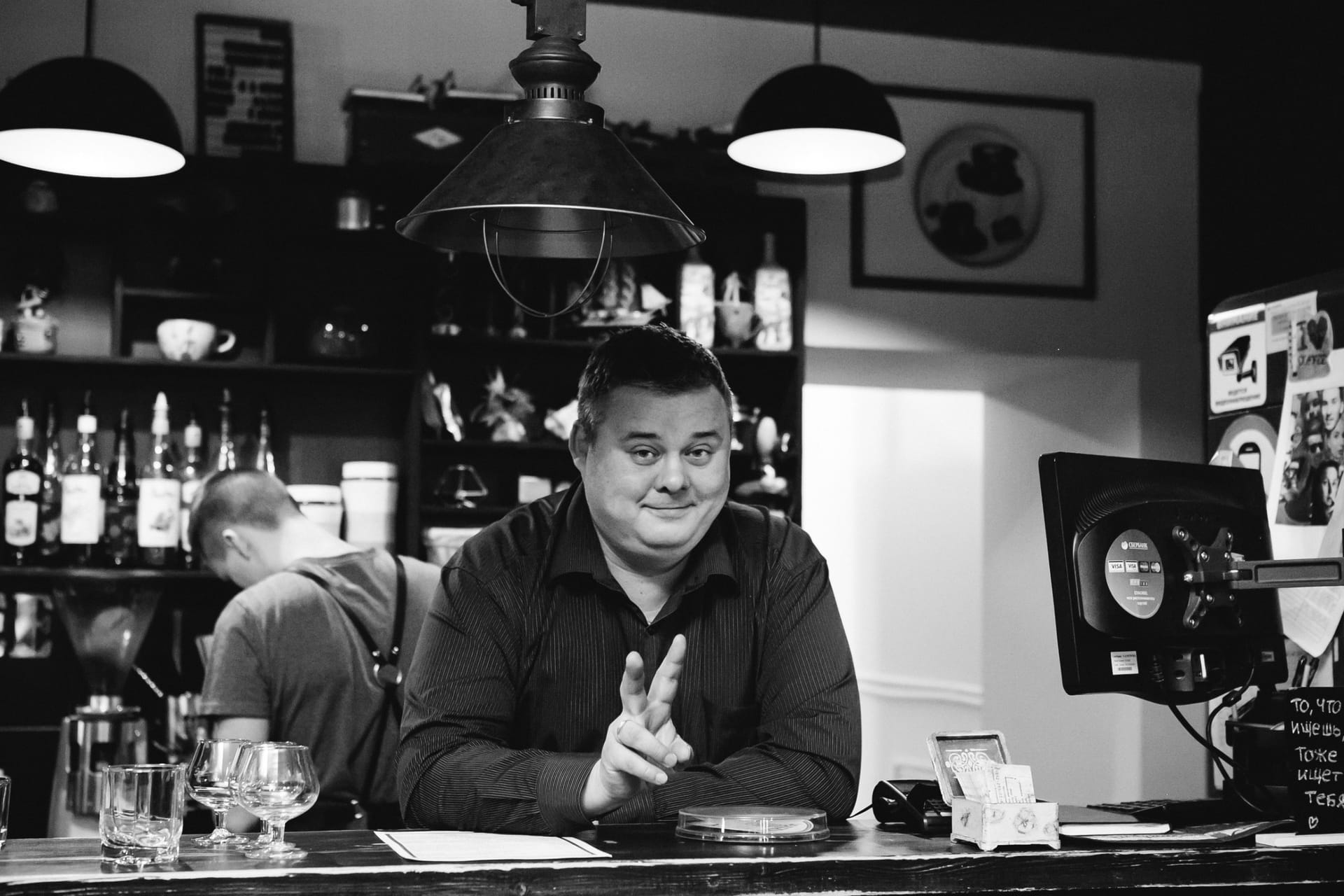
"What kind of word is 'Koryazhma'?" Blues conquers a small town in Arkhangelsk Oblast
In the Arkhangelsk region there is a small town called Koryazhma, in the center of which sits a café called "Pannorама" (yes, with two n's). And on the walls of this café hang posters: Chris Cain, Shana Waterston, Cory Harris. And the thing is, these posters weren't bought for decoration. All of these artists, whose names would do credit to any respectable European club's box office, have performed in Koryazhma.
Café owner Anton Duryagin, who for nine years has been bringing Russian and foreign bluesmen to the town, on how Koryazhma became one of the centers of attraction for bluesmen.
The first Black artist we had was Tom Atta from Great Britain. When I put up the posters, people reacted like: wow, someone from Great Britain is actually coming to some café in Koryazhma. Not to a cultural center, but to a café. Like, Duryagin's really showing off.
Anton Duryagin didn't take to blues right away — in his youth he listened to Russian rock classics, then played Romantic Collection CDs in his car, mostly enjoying slow "blues-tinged" tracks. His wife Irina, on the other hand, loves "imported" music, and when it came time to open a café, the couple immediately planned the space to accommodate touring musicians, and they themselves began attending festivals.
The first person I was introduced to — by chance or fate, however you want to look at it — was Tim Dorofeyev. And he performed with us periodically. They'd come play their own material and some classical pieces, and it was interesting. I understood that people liked it. There's a layer of people in our city who want more than just the fifth lineup of Vorovayok that gets wheeled into our community center. More quality music.
Then they invited Viktor Kolesov from Vologda, the organizer of the "Blues on the Veranda" festival.
And I was introduced to Yevgeny Kolbasheev, we became friends, and then somehow I started talking to him about how great it would be to bring someone over, foreign artists specifically. And that's how it started. Irina and I later remembered which countries our artists came from: Australia, Italy, the USA, Argentina, the Netherlands, Sweden, Belarus. There was even a guy from Japan.
And at the same time, I started getting to know the musicians who accompanied the foreigners — Yura Novgorodsky, Vasya Motylets. It's a shame there aren't many such people in Russia, maybe a hundred, and it turned out that whoever came once would come a second time and a third time.
The opening of this unusual source of music for the remote north has drawn not only locals—now audiences travel from Kotlas and other surrounding settlements for the concerts.
Roughly speaking, Voronov came to town. People ask: what, how is this possible, is it really him? He knows Keith Richards and Richards gave him a guitar. How did you manage to bring him to our Koryazhma? We don't get people like that even for City Day.
Or here, Jay C Smith came to visit, and I once took a photo with the poster for a group where he's standing with Mick Jagger. People went crazy over that too. Now when I put on a concert, people don't ask who this is or what this is anymore — they trust that it'll be good.
Our audience is a bit heavy, I've been in other cities where people are more relaxed. We're northern people—our emotions don't show as openly; there's that particular character to our city.
Foreign musicians not only come to Panorama with pleasure, but also periodically return, sometimes on a private basis.
There was an interesting story with Gregg Coffey Brown—he came to us with Tim Dorofeyev's band, and they went on to a festival in Arkhangelsk. So I pick him up from Kotlas and drive him. We're driving into Koryazhma, and we've got these wooden houses at the beginning of the street, and he's sitting there muttering something in English. I ask him, Grisha (that's what I called him), what's up? And someone translates for me: he says he grew up in Alaska, and he's looking at our snowdrifts and remembering his childhood—it really looks like Alaska. So he plays the concert, we go out on the porch, we're sitting there, smoking, it's snowing outside, quiet, already midnight, and he stands up and says I'll be back.
Then Cory Harris came to perform for me, and after the concert we're sitting around talking, and suddenly Grisha walks in—I mean Gregg. I was blown away, I say, hey Gregg. It had been about six months since his last visit. And he says: "I told you I'd come back."
He met a girl in Koryazhma and came to visit her. And he ended up at a Corey Harris concert. So it turns out two musicians met and got to know each other — one from Britain, the other from the USA — in a café in Koryazhma. That's quite a paradox.
The specificity of Koryazhma's geographic location is, in this respect, a separate point of interest for artists.
There were times when I had to urgently pick up guys from Arkhangelsk and bring them to me, or take them from me to Arkhangelsk. And the train schedule was inconvenient and took forever, so I'd drive the musicians myself more than once — that's 650 kilometers. And that's what really blows foreigners' minds.
So once I was driving with Luka Giordano, just the two of us. And me with my English… I know hello, goodbye, and thank you. And him—an Italian who only knows "spasibo" in Russian. So we're talking for nine hours straight. And I got the impression that I understood a lot of things. After about three hours, a third of the way there, he asks how much longer. I tell him, and he says: "I live in Italy, fifteen minutes by car and I'm swimming in the sea, fifteen minutes the other direction and I'm skiing down mountains." But here it's like this: half a day driving and you're still in the same region. That's what blows Europeans away—Americans take it easier, they've got big distances too."
Well, and how could we do without the notorious local color?
Or I met some Dutch guys in a car in Syktyvkar, coming from the airport. And when you're driving out of Syktyvkar, you're basically driving through taiga, to put it bluntly. All around you are spruce and pine trees, all that. And they were totally blown away too.
We made a technical stop, and we hear — wolves howling in the forest. Well, wolves are wolves, they howl and they howl, they didn't come after us. But the foreigners got their business done very quickly. Wow! Wolves! And they were already in the car. We drive on, and I'm cracking jokes — Russia, bears, all that sort of thing.
And our mayor, Andrey, was at the concert that evening. And suddenly he gets a call and rushes off somewhere urgent right from the concert. It's nine o'clock. Where did he run off to? He comes back about twenty minutes later.
We have this area on the outskirts, a neighborhood called Peschanka, private houses, and a bear wandered in there, a bear cub, but still the rangers came—it's not really good when a bear is walking around the city. They drove the bear out. And then I'm sitting with the artists, telling them this story. I say: "I thought I was joking."
Anton Duryagin has no plans to stop with his "privozos," and on the commercial side of things he says the following:
So we have Carlos Johnson playing next Monday. All seats are sold out, 60 tickets, and people are still asking to come, but where am I supposed to put them.
When Zhenya Kolbashev posted these tours online, people were surprised, like, Zhenya, where's that? Between normal cities? What's this weird word, "Koryazhma"? Where are you sending people? And he'd post the next tour for the next artist, and there's Koryazhma again.
But the point is something different—this isn't a story about making money. We're getting on in years now, though we like to think we're still young, still got some life in us. And that's why I need to do something for myself at least a few times a year. So we bring in artists, Russian and foreign, and we throw ourselves a little festival every two or three months. I do it for myself and my wife.
And do people come? That's wonderful! I don't even do any advertising—I just post the flyer and I know half the hall is already there. A core group of people has formed for whom this is just as important, just as valuable, just as much of a celebration.
I'm ready to translate Russian cultural and music journalism excerpts about blues history in Russia. Please provide the text you'd like me to translate, and I'll follow the critical rules you've outlined.