 People & Bridges. A Story of One Passion.On those who brought the blues to Russia
Dedicated to those who cared
People & Bridges. A Story of One Passion.On those who brought the blues to Russia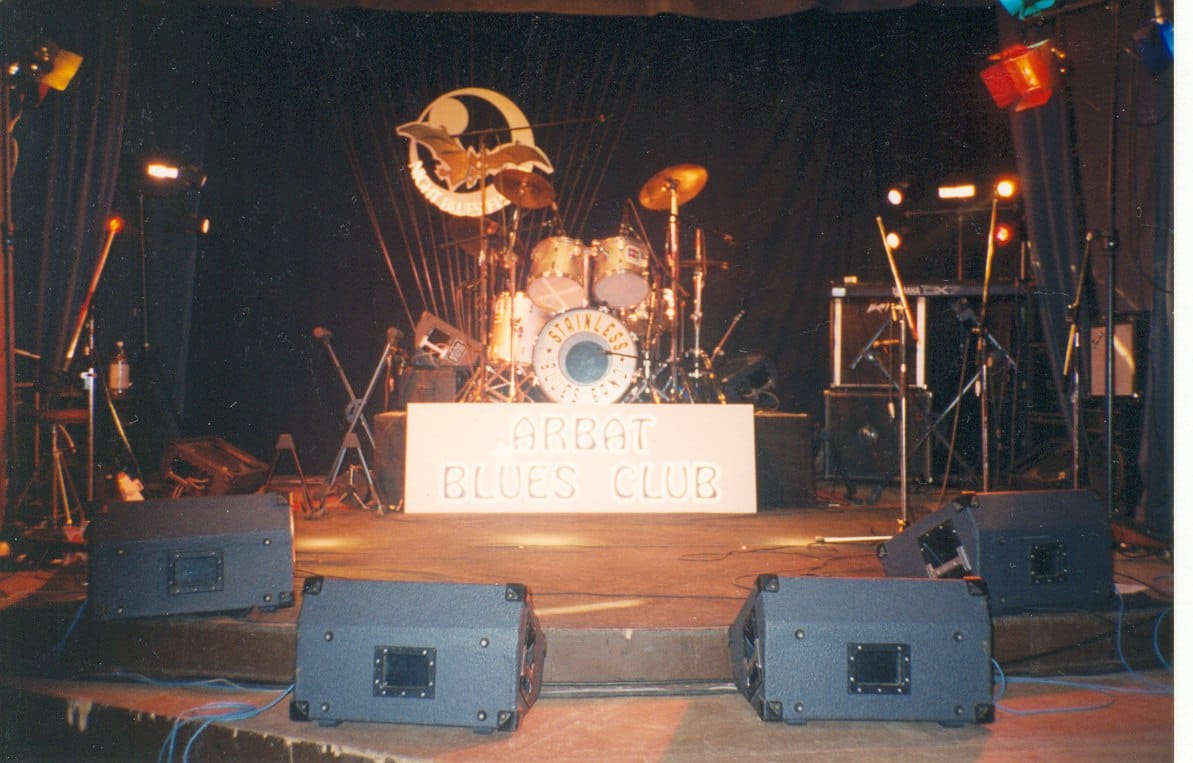
Alexander Tsarykov, founder of Arbat Blues Club, Russia's first blues club, on what Moscow's blues scene looked like in 1993, the emergence of the Blues Cousins group, and why Russians in the early '90s heard more blues musicians than pop performers—even though they didn't realize it.
Discovery
In ninety-two, the first music club opened in Moscow. I want to emphasize—not a restaurant, not a disco. There were plenty of those, and people sometimes start arguing about it. Well, basically the first truly music club where you could have a beer and listen to music. That was Sexton-First. It was a heavy music club, oriented primarily at the motorcycle crowd. The notorious Alexander Zladostanov was at the helm there. Some blues bands rushed in too, but it wasn't quite their audience.
And by that point there was a need for some kind of additional venue for a more intellectually inclined audience, with softer music. And to be honest, I didn't have any advance plan to organize a blues club.
It came about very spontaneously. Back then, my friends had a band called Old Men Blues Band. An American named John Anderson joined them at that time—he played harmonica and sang.
We met, talked, and John gave such a very good consultation.
"So in America we have these clubs, you know, a little Coca-Cola, a little beer, a little stage. And before the stage you absolutely have to dance."
We decided to give it a try. Because at that time there was a venue on the Arbat, in Filippovskiy Lane. It was the former Moscow Printing House No. 7 club building, and it had six-meter ceilings, a proper stage—not like nowadays, with all these tiny little bars where musicians are cramped in the background among beer bottles, practically touching elbows.
There was a real human scene there, a proper venue. And since I was involved in concert work, I had my own equipment—sound, lighting.
We decided to try putting on our first concert. That was the Old Man's Blues Band. And John put out a call to the embassies in Moscow back then.
It'll work out or it won't.
At 7 p.m. was the start time, I walked up to the door, cracked it open, and I got this chill inside because I saw a line stretching down the alley like people waiting for potatoes. The line went almost all the way to Arbatskaya metro.
To be honest, I was blown away by it. The hall was packed, absolutely packed. It was the very first concert. There was no advertising, no what they call rotation nowadays. That simply didn't exist back then.
The audience was mostly foreigners, with few Russians. Irina Surina came, there was Alik Mikoyan, guitarist of the "Serebryanniy Rubl'" group, and other musicians.
Everything sold out instantly at the bar, people were dancing in the hall. It was all great. It became clear we needed to keep going.
Concept
The second concert didn't draw quite as big a crowd, but it went well too. To add variety to the program, the band "Staraya Gvardiya" was invited. This is a blues band. Alik Sikorsky is the vocalist, a member of numerous groups that appeared even before "Mashina Vremeni". On drums was Mikhail Petrovich Sokolov, or simply Petrovich. On bass guitar was Alexei Shachnev, better known from the bands "Samotsvety" and "Plamya". On keyboards was, by the way, the quite young Denis Mazhukov. And on guitar was Valery Gelyuta, a legendary guitarist who, unfortunately, left us quite recently.
At first the concerts were once a week on Saturdays, then we decided to add Fridays too. Then we experimented: Thursday, Sunday, adding just one day at a time, then we moved to four days: Thursday, Friday, Saturday, Sunday. Well, to be honest, both Thursday and Sunday were quite unprofitable days. We cut them out later, and basically the club operated on Fridays and Saturdays.
We tried to diversify the bar too. There were some salads, pizza, and so on, but it wasn't a restaurant with a full kitchen, and people didn't go there just to eat—they went for the concert. And gradually the audience became more Russian.
The Audience
It was a certain middle class.
Back then it was like this: businessmen who carried those funny mobile phones that flipped open, and then a 60-centimeter antenna would slide out. That was still considered high class.
There were people who couldn't afford to go to a venue, to visit one somehow.
And the middle class was those who could afford to buy a ticket — we charged admission. More of a creative intelligentsia, really.
But the audience was very diverse, and gradually the foreign audience began to thin out and naturally get replaced by our own domestic audience, which was very pleasing.
In subsequent years, we created a system of club memberships. For example, musicians who performed regularly had membership cards and could enter free of charge any day.
The VIPs were mainly journalists who covered us in the press and on television. They also had free membership cards — beautiful ones with photographs.
For example, a director of a Moscow bank used to come to us. There's no such bank anymore now. It was basically an unofficial Luzhkov bank at the time. But he was very fond of blues music and enjoyed coming, and he'd get offended if people called him by his first and patronymic name.
Musicians
Around 1980 I was leading a band called "Pilgrim"—not the famous one that exists now, just a similar name. And we needed a guitarist. And a bassist, who's now a very well-known jazz double bass player, brought his friend.
A friend—forgive me, Lord—I get along very well with Borya Bulkin, but even so, he barely squeezed through the door. I was a bit shocked: "How are you supposed to play?" Fine. He came with this briefcase, and the briefcase was completely filled with radio parts. Just soldered, soldered little wires without circuit boards. He takes a guitar, and compared to him the guitar looked so small, plugs it into all this electronics. And starts playing extremely skillfully and extremely, extremely interestingly.
He was very narrowly focused on blues back then. My band didn't have that kind of narrow specialization, so we didn't end up working together, but at least we met and became friends.
And so in 1993 we invited him to us with his new band. To the Soviet, well, such a Soviet-perestroika-era audience, Borya Bulkin was known for two songs that were constantly broadcast on television.
An ad: there's this cartoon lemon walking across the screen singing "Make a sweet dream." That's it, that's exactly the band of Boris Bulkin. And there was another song, it was also shown somewhere about football and rock and roll.
I even joked back then that our blues performers were actually much more popular than pop singers, because their compositions were constantly playing on television. Like the Beeline-GSM commercial. Or "What Could Be Better" by Kolya Arutyunov.
Almost all the leaders of blues groups, they were heard in television advertising—it's just that it wasn't publicized.
There was a stellar collective, Stainless Blues Band, which was invited everywhere.
And here were two leaders of the blues scene — Liga Blyuza and Crossroadz; they stood somewhat apart back then, and their concerts on our stage happened less frequently.
In the club's early years, we tried to stay within rather narrow blues parameters—that's what we wanted.
At first we didn't allow Russian-language blues at all… Then those boundaries started to expand and we began adding a little country, a little jazz.
The now-famous Sergey Zhilin with "Fonograf," they also played here several times. The band "Kukuruza"—I didn't let them play for a long time…
Many people think that running clubs is profitable. No, I can tell you quite honestly, hand on heart: if you do everything honestly, it's a losing proposition. And I covered the losses from my touring income.
They'd take us somewhere to Ivanovo Oblast, to Rostov: we'd make some money, and we'd patch up the holes with it, fortunately there were plenty of tours in those days.
There were groups that drew bigger crowds and smaller ones. And I wouldn't want to offend anyone, God forbid—all the musicians were good, all the guys were great—but you had to pay attention to that too.
There was a band called Sky Stranger—that's Zhenya Badanov, who unfortunately suffered a stroke at 37 and essentially left the stage.
When it happened, that evening my shirt was just completely soaked. Because our girls, the staff, the performers, they all cried on me, because they were all in love with Zhenya Badanov. Zhenya Badanov was a handsome guy, with a great voice, moved beautifully on stage, had gymnastics training, could do the splits, walk on his hands across the stage right there.
Cry Baby, the band of Sasha Nikishin, one of our regular visitors, became a sponsor and even released a disc for them.
Petrovich's band didn't conquer our stage right away. I remember with a bit of a smile—we had two time slots: before midnight and after midnight. The more well-known bands played before midnight. After midnight, part of the audience would leave.
But some people stayed until 5:30, when the club closed and the metro opened. That is, it was that same middle class that came by metro and left by metro. There were fewer people at that time, and we booked bands for those hours that weren't as in demand.
There was also a band called White Spirit — just kids, really, straight out of amateur circles. They weren't even twenty years old, but they played blues, played The Rolling Stones, the real stuff. And literally in columns came the U.S. embassy Marines to see them. You'd look out at the audience and there'd be about twenty identical guys in white T-shirts that could barely button over their biceps. And they'd come in, sit down very neatly, all military-like, and listen — really listen — to this band.
Here's a funny story. When things were just getting started, two young guys came in, a couple of Georgians, and they said: "We play blues, take us on, we've got a guitar duo." I told them: "You know, I'd be happy to, but we have full bands playing here with bass, with drums…" In those days we were still sticking to those narrow blues frameworks. But these two literally followed us around everywhere.
And we suggested they join forces with another band that was playing at our place. They rehearsed right on our stage. We put together a program, and it was a huge hit. We named the band Blues Cousins. In a different lineup, but with the unchanging Levan Lomidze, it exists to this day. Levan is undoubtedly a virtuoso performer.